Another MONARCH Coffee Break Moment
A City, a Shuttle, a Strongman, and a Vancouver Case
Originally published October 5, 2026
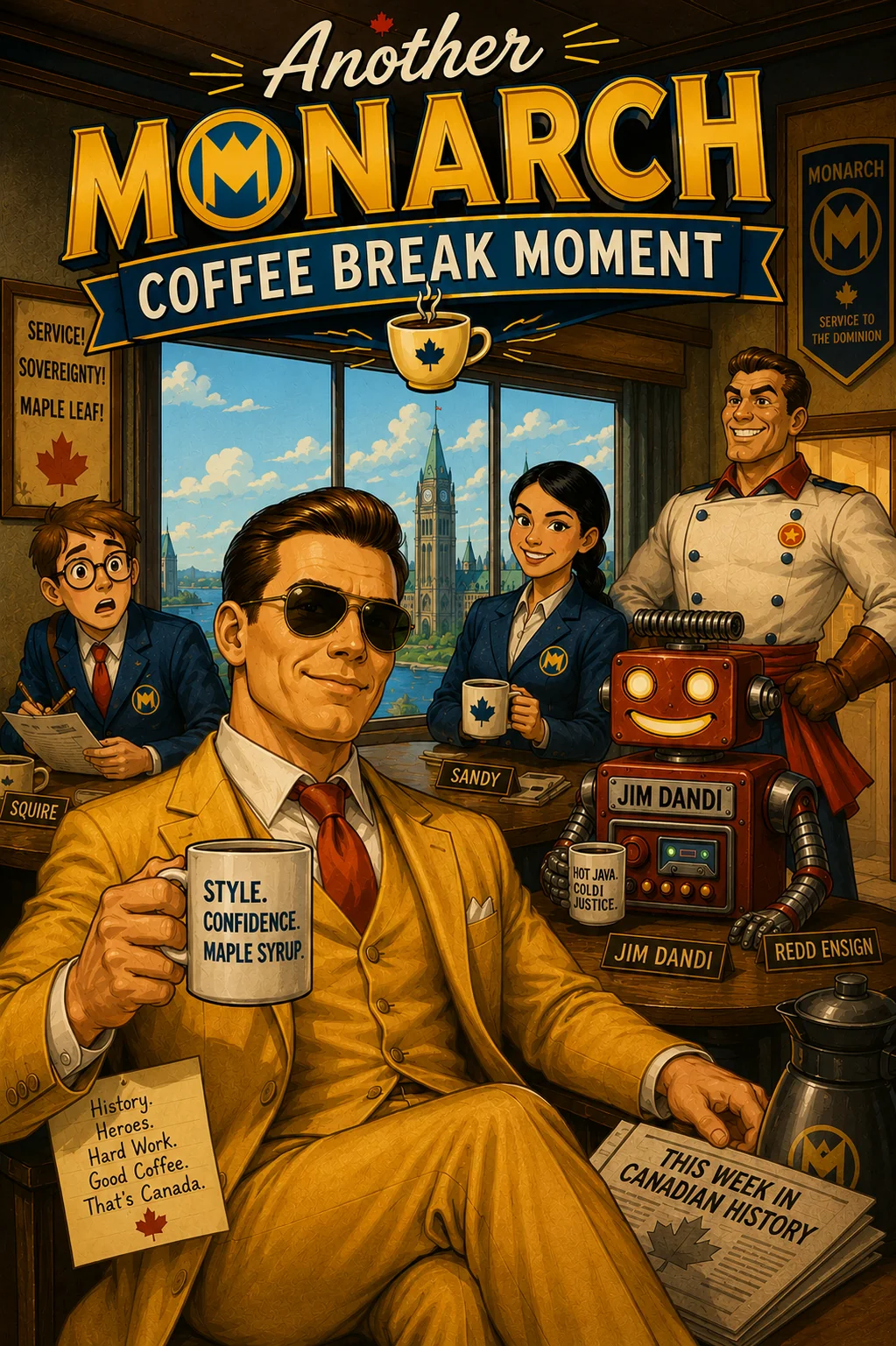
Another MONARCH Coffee Break Moment-A CITY, A SHUTTLE, A STRONGMAN, AND A VANCOUVER CASE
A Coffee Break visit to Edmonton, orbit, the strongman stage, and a Vancouver television set.
The coffee was hot. Well... most of it was.
There are few finer ways to begin a Monday than with a map large enough to endanger the kettle. I had Edmonton spread across most of the MONARCH break-room table when Sandy arrived, while JIM DANDI had placed a teaspoon on the north side of the North Saskatchewan River and was studying the result with considerable satisfaction.
Sandy stopped beside the table. “What is the teaspoon doing?” JIM explained that it was Edmonton. Sandy pointed out that it was, in fact, cutlery. JIM considered this distinction and decided the teaspoon was marking Edmonton, which seemed to him to settle the matter.
“Cartography has always been a developing science,” I said.
Sandy moved one corner of the map away from the kettle. “What are we actually doing?”
“Well now, this week Canada becomes a city, sends its first Canadian into space, welcomes a future strongman whose idea of ‘too heavy’ appears to have been largely theoretical, and puts a coroner on television.”
Sandy stared at me for a moment before pointing out that Canada had not become a city. Edmonton had. I agreed immediately and assured her that the remainder of the Dominion could retain its present arrangements. JIM shifted the teaspoon half an inch, asked whether that improved matters, and Sandy wisely chose not to answer.
“Start with Edmonton,” she said.
So we did.
October 8, 1904 — The City Across the River
On October 8, 1904, Edmonton was incorporated as a city. Municipal anniversaries can give history a slightly misleading air, because a date gets printed on a certificate and, more than a century later, it becomes tempting to imagine everybody waking up that morning to discover somebody had installed a city overnight.
Edmonton had already been growing for years beside the North Saskatchewan River. Trade, transport, settlement and local ambition were bringing people into the community, and by its 1904 municipal census Edmonton recorded 8,350 residents. That was quite a population to organize, and people have an unfortunate habit of requiring roads, services, public decisions and money to pay for all three.
In other words, city government.
A city is not merely a collection of buildings standing close enough together to become inconvenient. It is also an agreement among neighbours that certain things need doing and somebody had better work out how.
JIM looked down at the teaspoon. “So the certificate didn’t build anything? No houses, no sidewalks, nothing like that?”
“Not personally,” I told him.
He studied the map again. “That’s a lot of responsibility for a piece of paper.”
Sandy told him that this was almost exactly the opposite of what I had just explained. I took a sip of coffee and assured her that JIM was circling the point and might eventually land on it.
There was another complication on the map. Across the river stood Strathcona, with its own name, growth and ambitions. It became a town and then a city in its own right, and Edmonton and Strathcona did not immediately become the single municipality we know today. They were joined in 1912.
JIM responded by placing a sugar packet on the south side of the river. Sandy asked what it represented, and when JIM answered “Strathcona,” she reminded him that it was sugar.
“It can be two things,” he said.
“Careful, Jim,” I told him. “That kind of thinking is how metropolitan government begins.”
There is another detail worth getting right. We should not place Edmonton inside the Province of Alberta on its 1904 city birthday, because Alberta did not become a province until 1905. Edmonton then became the provincial capital, which means history once again declined to arrange itself in the tidy order we would have preferred: city first, province afterward, capital after that.
Beneath all of those municipal dates lies a much longer story. Indigenous peoples had lived, travelled, traded and gathered in the region long before anybody issued Edmonton a civic certificate. Incorporation marks the beginning of Edmonton’s legal status as a city; it does not mark the beginning of the place.
Sandy tapped that portion of the notes and said the distinction stayed exactly as written. I agreed. When she added, “Without a joke,” I considered the request and conceded that one occasionally has to ration them.
JIM lifted the teaspoon from the map. “So the record says city status, not instant metropolis.”
“Correct,” Sandy said.
He returned the teaspoon to the cutlery drawer, which counted as a small but meaningful victory for municipal precision.
October 5, 1984 — A Canadian Takes the Ride
From Edmonton we leave the municipal map behind and go somewhere considerably less convenient for road maintenance. On October 5, 1984, Marc Garneau launched aboard the space shuttle Challenger on mission STS-41-G and became the first Canadian in space.
After last week’s visit with Alouette, there is a useful distinction to make. Canada had already put Canadian-built hardware into orbit. Alouette I had gone up in 1962 and demonstrated that Canadian scientists and engineers could build an excellent scientific satellite, but machinery in space and a Canadian person in space are different chapters.
Garneau was aboard the shuttle as a payload specialist, working with Canadian experiments during the mission. For the first time, a Canadian was not merely looking upward at a national contribution to space science; one of us was along for the ride.
JIM looked up from his mug and asked how much room a person actually had aboard a space shuttle. Sandy glanced at the position of his elbows and suggested it was probably less than he currently occupied at the break-room table. JIM pulled one arm inward and decided space sounded cramped.
“Space,” I told him, “is notoriously badly named.”
Garneau’s flight mattered partly because firsts matter. A country remembers the first person who crosses a threshold, but the fellow in the photograph is never the whole story. Spaceflight depends upon engineers, scientists, trainers, technicians, planners and entire teams of people who become considerably less famous than the person strapped into the spacecraft.
It involves spectacular launches, certainly, but it also involves checklists, repeated practice, careful experiments and people trusting one another not to decide that today is an excellent day to improvise. That last requirement alone would disqualify several members of MONARCH.
Sandy looked at me. “You mean Redd.”
“I named no names.”
“You looked at the door.”
“Professional instinct.”
Garneau’s flight widened something in the Canadian imagination as well. Science, engineering and spaceflight no longer belonged entirely to somebody else’s national story. Canadian laboratories and engineers had already contributed to space science; now there was a Canadian aboard the spacecraft.
A job that had once seemed unimaginably distant suddenly had a Canadian name attached to it.
JIM looked toward the ceiling and asked whether Garneau could see Canada from orbit. I told him he could certainly see parts of it, but when JIM asked whether he could see the whole country at once, I pointed out that we had difficulty fitting Canada on the break-room table.
He nodded. “Fair.”
That is one of the useful things about a first. Once somebody does it, the impossible begins to look suspiciously like a profession.
October 10, 1863 — Louis Cyr Arrives
On October 10, 1863, Cyprien-Noë Cyr was born at Saint-Cyprien in Lower Canada. The world would eventually know him by a rather more famous name: Louis Cyr.
There was a time when professional strongmen were major public entertainment. Long before television could provide athletes around the clock, crowds paid to watch exceptionally powerful men lift, carry, restrain and otherwise disagree with objects that ordinary people had sensibly decided were too heavy.
Louis Cyr was very good at disagreeing.
Over a public career lasting more than two decades, Cyr performed thousands of times in Canada, the United States and England and became famous for feats of strength that sound as though somebody had neglected to explain the normal purpose of the human skeleton. Among the feats associated with his career were restraining pairs of horses and performing a back lift with a loaded platform weighing close to 4,300 pounds.
JIM stopped halfway through raising his coffee mug.
“Four thousand three hundred pounds?”
“Close to it.”
“With his back?”
“That is generally the portion of the story people remember.”
JIM carefully put his mug down with both hands.
Sandy glanced across the table. “Don’t get ideas.”
“I’m not built for ideas that heavy.”
Cyr had worked as a labourer and lumberjack and would also serve as a policeman before his extraordinary strength became the centre of his public career. His performances made him famous well beyond Quebec, and his reputation endured long after the travelling strongman era itself had largely disappeared.
There is an interesting difference between strength and spectacle. Strength can exist quietly. A strongman’s business was to make it visible. An audience had to see the horses strain, watch the weights rise, and understand that the fellow standing in front of them could do something the rest of the room could not.
Which naturally made me wonder about Redd.
He had entered during the account and was standing by the counter pouring coffee. Normally, the discovery of an exceptional Canadian achievement is enough to produce an address, an expedition or at minimum an unnecessary salute.
Louis Cyr had produced none of these.
Sandy noticed it too. “Nothing to add?”
Redd looked over. “About Mr. Cyr?”
“Yes.”
He considered the photograph in the file and gave it a respectful nod. “A strong Canadian. Admirable.”
Sandy waited.
So did I.
Redd added a little milk to his coffee.
“That’s it?” she asked.
“What more requires saying?”
There are moments when a perfectly ordinary answer becomes interesting solely because of the person who gave it. I looked at Redd, looked at Cyr’s photograph, and decided that Monday morning did not require every mystery solved before the second pot.
JIM, meanwhile, was still considering the number.
“Four thousand three hundred.”
“Leave the furniture alone,” Sandy said.
“I wasn’t going to do anything.”
“You were looking at the table.”
“It started it.”
October 7, 1998 — Vancouver Takes the Case
From the strongman stage we return to considerably lighter paperwork and arrive in Vancouver. On October 7, 1998, Da Vinci’s Inquest debuted on CBC television.
The series followed Dominic Da Vinci, a fictional Vancouver coroner whose work placed him amid investigations where the central questions were often difficult rather than glamorous. What happened? Who was affected? What can the evidence actually establish?
I have always admired any profession that requires facts to remain in the room until everyone has acknowledged them.
Sandy looked up from her notes. “You would find that arrangement difficult.”
“I would find it noble.”
“You would try to give the facts a dramatic entrance.”
“Only when justified.”
JIM had become interested for entirely different reasons. “So his job involved records?”
“Evidence, investigation, medical findings, witnesses and circumstances,” I said. “Rather more than filing.”
“But records were involved?”
“Almost certainly.”
JIM sat straighter. “Good show.”
We should not mistake a television drama for a documentary. Writers construct episodes, characters are shaped for storytelling, and real investigations do not normally arrange themselves so that everybody reaches a satisfying revelation shortly before the closing credits. Real life has very poor respect for episode length.
But Da Vinci’s Inquest did something worth noticing. It placed a recognizably Canadian city at the centre of its story, and Vancouver was not merely a pretty skyline inserted between scenes. It was the setting in which the people, institutions and problems of the drama existed.
That matters, especially coming one week after our stop with The Beachcombers. That series allowed the Sunshine Coast to remain unmistakably British Columbian. A generation later, Vancouver could carry an urban investigative drama without pretending to be somewhere else.
The two programs were very different. One gave us boats, log salvage and a coastal community; the other gave us a coroner asking uncomfortable questions in a large city. Both, however, made the same quiet assumption: Canadian places were interesting enough to be the places where stories happened.
JIM nodded approvingly. “So Vancouver played Vancouver.”
“Yes.”
“Did it have to audition?”
Sandy stared at him. “For being Vancouver?”
“Seems like it would have an advantage.”
I lifted my mug. “Strong local experience.”
Back to the Kettle
By this point the Edmonton teaspoon had returned to active service, the shuttle had safely remained several hundred kilometres above our heads, JIM had reconsidered the load-bearing capacity of several items of break-room furniture, and he had begun wondering whether the MONARCH archives technically qualified as forensic evidence. Sandy closed the history file and asked for the tally.
I counted it off. A growing community discovers that becoming a city does not magically solve the work of being one. A Canadian goes into space. One of the most celebrated strongmen in Canadian history demonstrates that “too heavy” is occasionally a matter of opinion. Vancouver gets a television coroner.
JIM immediately volunteered Louis Cyr as his favourite. Sandy reminded him that history was not being ranked according to lifting capacity, while Redd quietly continued drinking his coffee.
The four anniversaries are very different, but they are not entirely unrelated. Cities do not build themselves, space missions do not fly themselves, remarkable strength still has to be trained and put to use, and investigations—fictional or otherwise—do not solve themselves. Somebody does the work, somebody checks the details and somebody keeps the records.
JIM brightened. “I knew records were coming back.”
“And sometimes,” I continued, “a country becomes easier to recognize when its own people, achievements, institutions and places are allowed to take centre stage.”
The break-room door opened before Sandy could decide whether that qualified as a proper conclusion. Redd had apparently slipped out during the recap and now returned carrying an enormous pair of ceremonial scissors, his long voyageur toque trailing behind him as usual and his red sash slightly askew from whatever preparations he had just been making.
Sandy looked at the scissors. “No.”
Redd stopped in the doorway. “You have not heard the proposal.”
“I don’t need to.”
He advanced toward the table with considerable ceremony and announced that, having reviewed Edmonton’s elevation to civic status, he had concluded that the MONARCH break room possessed every necessary quality of an incorporated municipality.
JIM looked around. “We do have chairs.”
Redd pointed toward him. “Population!” He then indicated the sink and declared it public utilities, identified the kettle as essential infrastructure, and finally gestured toward the overflowing notice board as evidence of municipal bureaucracy.
I slowly lowered my coffee. “He has assembled a surprisingly coherent case.”
“Do not help him,” Sandy said.
Redd planted the ceremonial scissors on the table and announced the immediate incorporation of the City of MONARCH Break Room, a proud and self-governing civic entity within Royale City. JIM raised one hand and asked who would be mayor.
Redd froze.
His eyes travelled slowly around the room. Sandy folded her arms, I took another sip of coffee, and JIM waited with the patient interest of a citizen who had accidentally discovered constitutional trouble.
At last Redd looked down at the scissors. “This matter may require a committee.”
“There it is,” Sandy said.
JIM nodded. “Definitely a city.”
Redd gathered the scissors and announced that he would return once the civic framework was complete. He marched out with as much dignity as a man can manage while carrying oversized ceremonial scissors, only to reappear several seconds later and ask whether the kettle belonged to the new municipality or remained federal property.
Sandy pointed down the corridor, and the door closed again.
She was about to collect the files when she stopped.
“Wasn’t the records cabinet against that wall?”
JIM looked over. “Yep.”
It was now on the opposite side of the room, leaving a broad empty space where Redd had apparently intended to establish his municipal offices.
Sandy frowned. “When did that move?”
JIM turned toward the door through which Redd had just disappeared. “Must’ve been while we were talking.”
Sandy looked at the cabinet, then at me. “That thing took four people and a trolley to get in here.”
I followed her gaze toward the corridor, remembered Louis Cyr, and took a thoughtful sip of coffee.
“Municipal enthusiasm,” I said, “is a powerful force.”
The coffee had gone cold, the doughnuts had vanished, and thus another MONARCH Coffee Break Moment had come to a close. Until the next pot is brewed.
Do you know what’s better than making it to the end of another M.O.N.A.R.C.H. adventure with your dignity mostly intact?
Liking and subscribing to Redd Ensign’s adventures on all your favourite interweb hangouts—especially right here on Substack.
And while you’re at it, spread the word. Tell your friends about Redd, Soash, Sandy, Squire, JIM DANDI, Big Joe, and the rest of the gang. They may thank you. They may nod politely while backing away from the refreshments table. Either way, M.O.N.A.R.C.H. grows stronger.
And if you are looking for a church where the Bible is sincerely believed and faithfully taught, you are warmly encouraged to visit a local United Reformed Church. These are places of reverent worship, joyful fellowship, and faithful preaching. There is even a congregation here in New Westminster. While M.O.N.A.R.C.H. is not affiliated with the URCNA, you can find a nearby congregation through the denomination’s church locator.
Until next time, keep defending the Dominion.
— Shane Boivin
M.O.N.A.R.C.H. Historian