Redd Ensign Presents: M.O.N.A.R.C.H.’s Cabinet of Curiosities
UNEXPECTED TURNS — Five Canadian Stories That Refused to Go According to Plan
Originally published October 29, 2026
A NOTE FROM ACTING HISTORIAN JIM DANDI
Morning, citizens.
JIM DANDI here, Acting Historian, Temporary Keeper of the Publishing Desk, and the fellow who has been told several times now that “temporary” does not mean I can move Shane’s desk closer to the electrical outlet.
I was around his office this morning doing a perfectly legitimate archival inspection. I was not in snooze mode, low-power mode, standby mode, or “resting my optical sensors for a minute,” despite what Soash may tell you.
Shane’s desk was empty.
Well, not empty empty. There were three pencils, a cold mug, seventeen pieces of paper that may or may not form a filing system, and something underneath a stack of books that I have chosen not to investigate without gloves.
But there was no Cabinet article.
Then I turned around.
Then I turned back.
And there was a Cabinet article sitting in the middle of the desk.
I have checked the security log, the hallway camera, the sub-sub-basement pneumatic tube, and the little door behind the filing cabinet that everybody insists is “probably nothing.”
Nothing.
So, seeing as this is clearly M.O.N.A.R.C.H. business and it already has Redd’s name on it, I have stamped it RECEIVED, MYSTERIOUSLY, and DO NOT LOSE THIS ONE, and I am posting it as found.
Still no Shane.
Still no pith helmet.
Flux capacitor status remains: warmer than I would like.
Anyway, here’s the Cabinet.
— JIM DANDI
Acting M.O.N.A.R.C.H. Historian
Until Somebody More Qualified Reappears
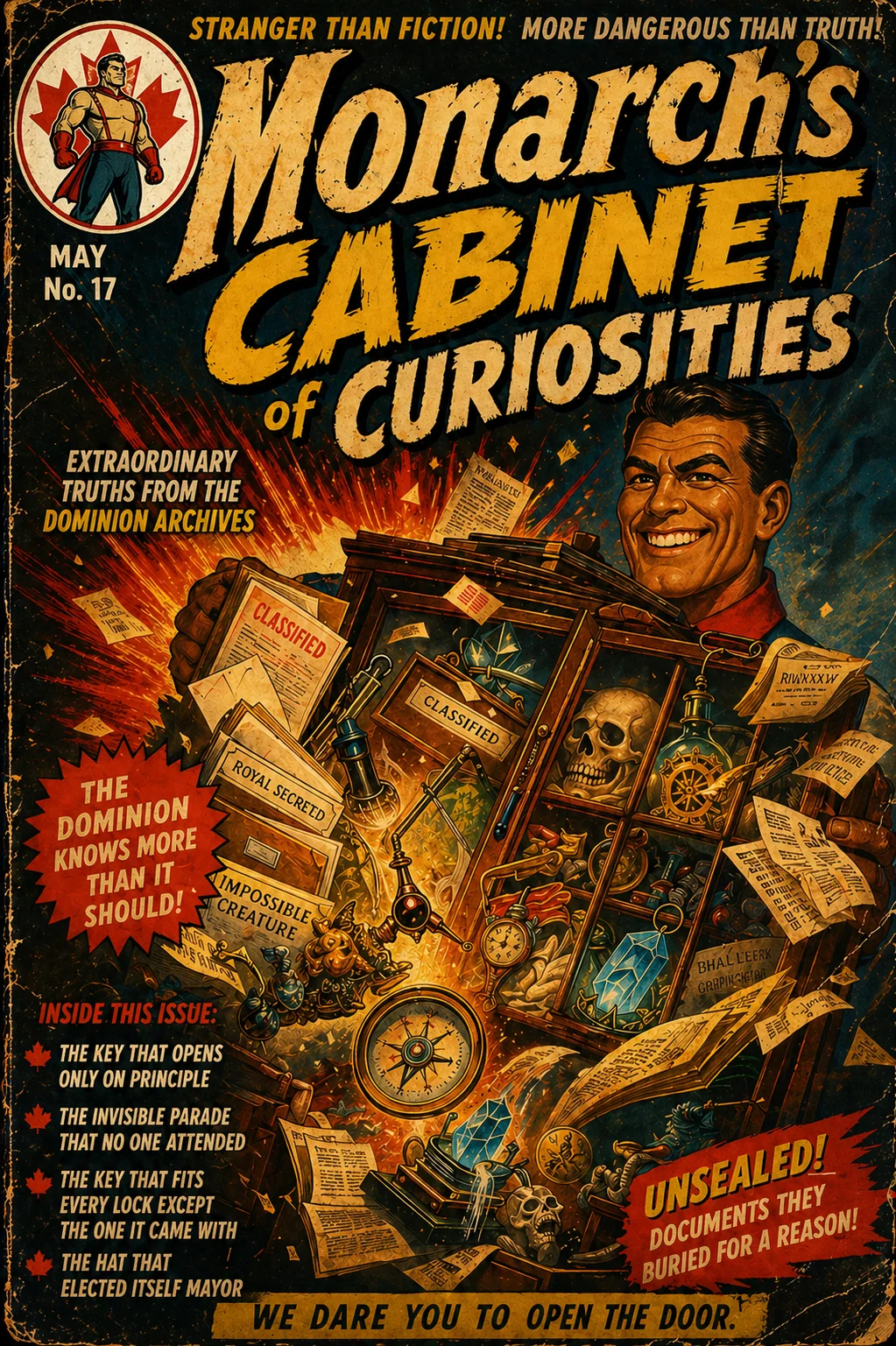
Redd Ensign Presents: M.O.N.A.R.C.H.’s Cabinet of Curiosities
Citizens! Scholars! Loyal observers of the Dominion’s magnificent peculiarities!
Stand tall, adjust your hats, and prepare your hearts, for once again we gather before one of the most remarkable institutions in the entire heroic apparatus of our great nation.
I speak, of course, of M.O.N.A.R.C.H.’s Cabinet of Curiosities—a dignified repository where the improbable reports for duty and the extraordinary salutes politely before entering the permanent record of Canadian history.
This Cabinet is not merely a piece of furniture, though it is indeed a very respectable one. It is a wooden citadel of drawers and brass handles, each compartment guarding some moment so astonishing that even the most disciplined archivist has occasionally leaned back in his chair, removed his spectacles, and declared with quiet conviction, “Good heavens.”
Within these drawers reside events that may appear improbable to the untrained eye. Yet every entry has been examined, stamped, cross-checked, and placed under the respectful supervision of history itself. If a fact appears too remarkable to believe, we inspect it again until it either stands upright and presents its credentials or is escorted politely back into the rumour pile.
That, citizens, is how we conduct scholarship in M.O.N.A.R.C.H.—with dignity, with patience, and occasionally with a magnifying glass and a thermos of strong tea.
Whenever we approach this Cabinet, we do so with the solemn courage of librarians and the steady curiosity of explorers who have already packed sensible footwear and emergency sandwiches. One drawer is selected, one drawer is opened, and whatever wonder history has placed inside is presented proudly to the Dominion.
And now, citizens…
By the bent spike of Craigellachie and every screwdriver that has behaved itself since!
Let us proceed.
Tonight’s record is found in Drawer U.
The file is labelled:
UNEXPECTED TURNS
Five Canadian Stories That Refused to Go According to Plan
History Misreads the Instructions
Citizens, plans are admirable things.
A plan tells a traveller where to go, an engineer what to build, an aviator where to land, a railway director where to strike, and a train robber which particular railway car contains the money.
The difficulty is that history does not always read the plan.
Sometimes the screwdriver slips. Sometimes the spike bends. Sometimes the robber uncouples the wrong railway car. Sometimes the medicine catches fire on the way to the epidemic. And sometimes a railway crew goes out to clear one avalanche only to have another one descend from the opposite mountain.
At such moments, Canada has generally adopted the traditional national procedure.
Deal with it.
Tonight, therefore, the Cabinet examines five occasions when events took an unexpected turn and somebody had to decide what happened next.
The Screwdriver Bites Back
Peter Lymburner Robertson was not trying to revolutionize the Canadian toolbox.
He was trying to demonstrate one.
Around the beginning of the twentieth century, Robertson was travelling as a tool salesman when the blade of a conventional screwdriver slipped from the screw and cut his hand. Anyone who has ever attempted to drive a stubborn slotted screw while crouched beneath a sink may pause here to recognize an ancient enemy.
Robertson did something more useful than complain.
He began thinking about a screw and driver that would stay together.
The result was the tapered square socket that became the Robertson screw. Earlier square-drive ideas had existed, but Robertson developed a design that could be manufactured efficiently and held the driver firmly enough to reduce slipping. He patented his system in Canada in 1909, established production in Milton, Ontario, and soon found customers among boatbuilders, electricians, manufacturers and eventually the automobile industry.
Citizens, consider the chain of events.
A screwdriver slips.
A hand is cut.
The injured salesman studies the offending tool.
And instead of declaring the screwdriver an enemy of civilization, he improves civilization’s screwdriver.
There is something deeply satisfying about an invention whose origin can be reduced to the sentence:
“That hurt. There must be a better way.”
The Cabinet therefore records that one of Canada’s most familiar tools owes at least part of its existence to a tool that failed to remain where Peter Robertson had put it.
The screwdriver drew first blood.
Robertson won the argument.
The Last Spike Requires a Second Attempt
On November 7, 1885, the eastern and western sections of the Canadian Pacific Railway finally met at Craigellachie, British Columbia.
This was not merely another stretch of track.
The railway had been one of the great promises holding Confederation together. British Columbia had entered Canada with the expectation that a railway would connect it to the rest of the country, and after years of surveying, construction, financial strain, political trouble, engineering difficulties and mountains of the particularly unreasonable British Columbian variety, the rails had at last joined.
A small group gathered for the ceremony.
There was no enormous golden spike.
There was an ordinary iron one.
Donald Smith, later Lord Strathcona, lifted the hammer to drive it.
And bent it.
The spike intended to symbolize the completion of one of the greatest engineering projects in Canadian history was removed and replaced. Smith tried again, the second spike went in properly, the photograph was taken, and William Van Horne marked the occasion with an admirably economical speech: the work, he said, had been well done. Historical railway accounts preserve the wonderfully human detail that Smith’s first blow had glanced off and bent the ceremonial spike.
Citizens, I find this reassuring.
Canada had spent years blasting, bridging, grading and laying a railway across forests, muskeg, prairie and mountain ranges. Engineers had solved problems of distance, elevation, weather and finance on a continental scale.
Then, at the decisive moment, somebody bent the nail.
History did not stop.
Nobody announced that Confederation would have to be reconsidered.
They fetched another spike.
That second spike helped produce one of the most famous photographs in Canadian history, while the unfortunate first one became an excellent reminder that even national destiny occasionally requires someone to say, “Have we got another?”
The railway reached the Pacific.
The first spike merely took the scenic route to the museum.
The Gentleman Bandit Selects the Wrong Car
Bill Miner was an experienced criminal.
This fact makes what happened near Kamloops considerably better.
Miner had already participated in a successful Canadian Pacific Railway robbery near Mission in 1904, escaping with thousands of dollars. By May 1906, he returned to the railway with two accomplices and attempted another hold-up near Ducks Station, east of Kamloops.
The plan had promise.
The execution had liver pills.
Miner and his men stopped the train and ordered the locomotive and a railway car separated from the rest of it. There was only one difficulty: the car containing the valuable express shipment remained behind.
The robbers had uncoupled the wrong one.
According to Library and Archives Canada, a safe containing about $35,000 in gold was left in the express car still attached to the passenger train. While searching mail sacks in the car they had actually taken, the bandits also overlooked a package containing more than $40,000 in cash.
Their final haul amounted to $15.50 and a bottle of liver pills.
Citizens, crime does not pay.
On this occasion, it barely covered lunch.
Miner had spent decades developing a reputation as the so-called “Gentleman Bandit,” an outlaw sufficiently polite and theatrical to become a western legend. Yet somewhere east of Kamloops, years of criminal experience encountered the simple administrative requirement of selecting the correct railway car.
It did not go well.
A manhunt followed, Miner and his companions were captured, and the gentleman bandit was eventually sent to the penitentiary in New Westminster.
One imagines the inventory at the conclusion of the operation.
Money missed: considerable.
Gold missed: considerable.
Freedom: lost.
Liver pills: acquired.
The Cabinet does not endorse railway robbery.
It does, however, insist upon accurate filing.
And this robbery belongs under M — Miscalculation.
The Medicine Catches Fire
In late 1928, word began travelling south from northern Alberta that a suspected outbreak of diphtheria threatened the communities around Fort Vermilion and Little Red River.
There was antitoxin in Edmonton.
There were hundreds of kilometres of winter between Edmonton and the patients.
That was the problem.
A message from the north eventually reached provincial health officials, and aviator Wilfrid “Wop” May agreed to carry the desperately needed serum north with fellow pilot Vic Horner in a tiny open-cockpit Avro Avian.
They departed Edmonton on January 2, 1929, in bitter cold.
The serum had to be kept from freezing, so it was wrapped in a blanket and placed near a charcoal heater.
This solved one problem.
It introduced another.
Smoke began coming from the baggage compartment.
The heater had set the blanket on fire.
May and Horner landed, removed the burning material, and then continued north while keeping the antitoxin warm with their own bodies—carrying it beneath their arms and between their legs inside an aircraft whose cockpit was open to the winter air. They fought severe cold, poor weather and mechanical trouble before reaching Fort Vermilion, where the serum was delivered successfully. On the return trip, automobile gasoline had to be used when aviation fuel was unavailable, causing further difficulties. By the time the pair returned to Edmonton, thousands of people had gathered at Blatchford Field to welcome them home.
Citizens, the Cabinet has reviewed the paperwork.
At no point does “the medicine catches fire” normally appear in the recommended procedure for a medical mercy mission.
May and Horner simply continued.
That is what makes the story remarkable. The famous part is not merely that two aviators flew into the northern winter carrying lifesaving medicine. The trip seems determined to add one difficulty after another until ordinary transportation begins looking wistfully attractive.
The message took days to reach Edmonton.
The aircraft had an open cockpit.
The temperature fell far below freezing.
The serum could freeze.
The blanket caught fire.
The proper fuel ran out.
The return flight encountered a snowstorm.
Yet the medicine arrived.
The Cabinet therefore classifies the expedition under that rarest and most admirable category of Canadian transportation:
The plan failed repeatedly. The mission did not.
The Avalanche Gives One Man Back
Our final file carries a heavier weight.
On the night of March 4, 1910, railway workers at Rogers Pass in British Columbia were clearing snow from the Canadian Pacific Railway line after an avalanche had descended from Mount Cheops.
The men were working in the cut behind a rotary snowplow.
Then another avalanche came down from the opposite side of the pass.
Fifty-eight men were killed.
It remains the deadliest avalanche disaster in Canadian history.
Among those caught in it was railway fireman William “Bill” Lachance. Old accounts turned his survival into something almost unbelievable, describing him as being thrown and churned through the moving snow before emerging alive. Revelstoke Museum and Archives confirms that Lachance survived after being tossed about in the avalanche, although later research has corrected the long-repeated claim that he was the disaster’s only survivor; evidence indicates that at least two Japanese workers survived as well.
That correction belongs in the Cabinet.
A remarkable story does not become less remarkable because history becomes more accurate.
Lachance survived something that killed dozens around him, but the larger story of Rogers Pass did not end with one man climbing out of the snow. The railway had spent years battling avalanche danger in the Selkirks, using snowsheds and enormous efforts to keep the line open. The 1910 disaster became part of the accumulating evidence that the mountain route could not simply be fought forever from the surface.
The railway eventually went underneath.
The Connaught Tunnel, opened in 1916, carried the CPR beneath the most dangerous section of Rogers Pass and allowed the old summit route to be abandoned. Parks Canada identifies the 1910 avalanche as an important factor in the decision to move the railway underground.
Citizens, there are moments when persistence means continuing forward.
There are other moments when persistence means admitting that the mountain has won the argument and finding another way through it.
Rogers Pass taught Canada both lessons.
Believe It or Not…
The Cabinet opened Drawer U expecting mishaps.
It found something more interesting.
Peter Robertson cut his hand and redesigned the screwdriver. Donald Smith bent the spike meant to symbolize completion of the Canadian Pacific Railway, so another spike was produced and the railway became history anyway. Bill Miner selected the wrong railway car and transformed an ambitious robbery into fifteen dollars, fifty cents and pharmaceutical assistance. Wop May and Vic Horner watched the blanket around their lifesaving medicine catch fire and carried on toward Fort Vermilion. At Rogers Pass, Bill Lachance survived an avalanche whose terrible cost helped convince the railway that the safest route across the mountain was eventually beneath it.
None of these stories unfolded according to plan.
That is precisely why they belong here.
History is often presented afterward as though everyone involved knew what would happen. The railway was destined to cross the continent. The invention was waiting to be invented. The pilot would reach the settlement. The engineer would solve the mountain. The photograph would be taken at exactly the right moment with exactly the right spike.
The Cabinet knows better.
Real history contains bent iron, bleeding knuckles, wrong railway cars, burning blankets, bad weather, human error, improvisation, courage, stubbornness and the occasional bottle of liver pills.
Canada was not assembled by people following an immaculate set of instructions.
Quite often, it was assembled by people discovering that the instructions were no longer useful and deciding what to do next.
Citizens, perhaps that is why the Cabinet has so many drawers.
Perfect plans require very little filing.
Unexpected turns produce stories.
And so, citizens, another remarkable entry takes its place within the records of the Dominion. The curiosities have been examined, the facts have saluted, and the lesson has been properly filed.
Drawer U is now returned to its rightful position within M.O.N.A.R.C.H.’s Cabinet of Curiosities, where it shall remain ready for inspection by any citizen equipped with a steady sense of wonder, a properly fitted screwdriver, and the wisdom to check which railway car contains the money before commencing any entirely lawful journey.
Until our next visit to the Cabinet, keep your curiosity polished and your questions courageous.
The record shall stand.
This has been M.O.N.A.R.C.H.’s Cabinet of Curiosities.
Good night, citizens—and mind the drawers.
Do you know what’s better than making it to the end of another M.O.N.A.R.C.H. adventure with your dignity mostly intact?
Apparently I am required to tell you that the answer is liking and subscribing to Redd Ensign’s adventures on all your favourite interweb hangouts—especially right here on Substack.
So please do that.
Also, spread the word. Tell your friends about Redd, Soash, Sandy, Squire, Big Joe, yours truly, and the rest of the M.O.N.A.R.C.H. gang. They may thank you. They may nod politely and begin moving toward another refreshments table. Both responses have been recorded previously and are considered acceptable.
And if you are looking for a church where the Bible is sincerely believed and faithfully taught, Shane always makes a point of inviting readers to visit a local United Reformed Church. I checked the file, and he was right to do so. These are places of reverent worship, joyful fellowship, and faithful preaching. There is even a congregation in New Westminster. M.O.N.A.R.C.H. is not affiliated with the URCNA, but you can use the denomination’s church locator to find a congregation near you.
Until next time, keep defending the Dominion.
And if anybody sees Shane, please tell him his paperwork is beginning to reproduce.
—
JIM DANDI
Acting M.O.N.A.R.C.H. Historian
Shane Boivin still officially listed as “Missing, Probably Doing
Something”