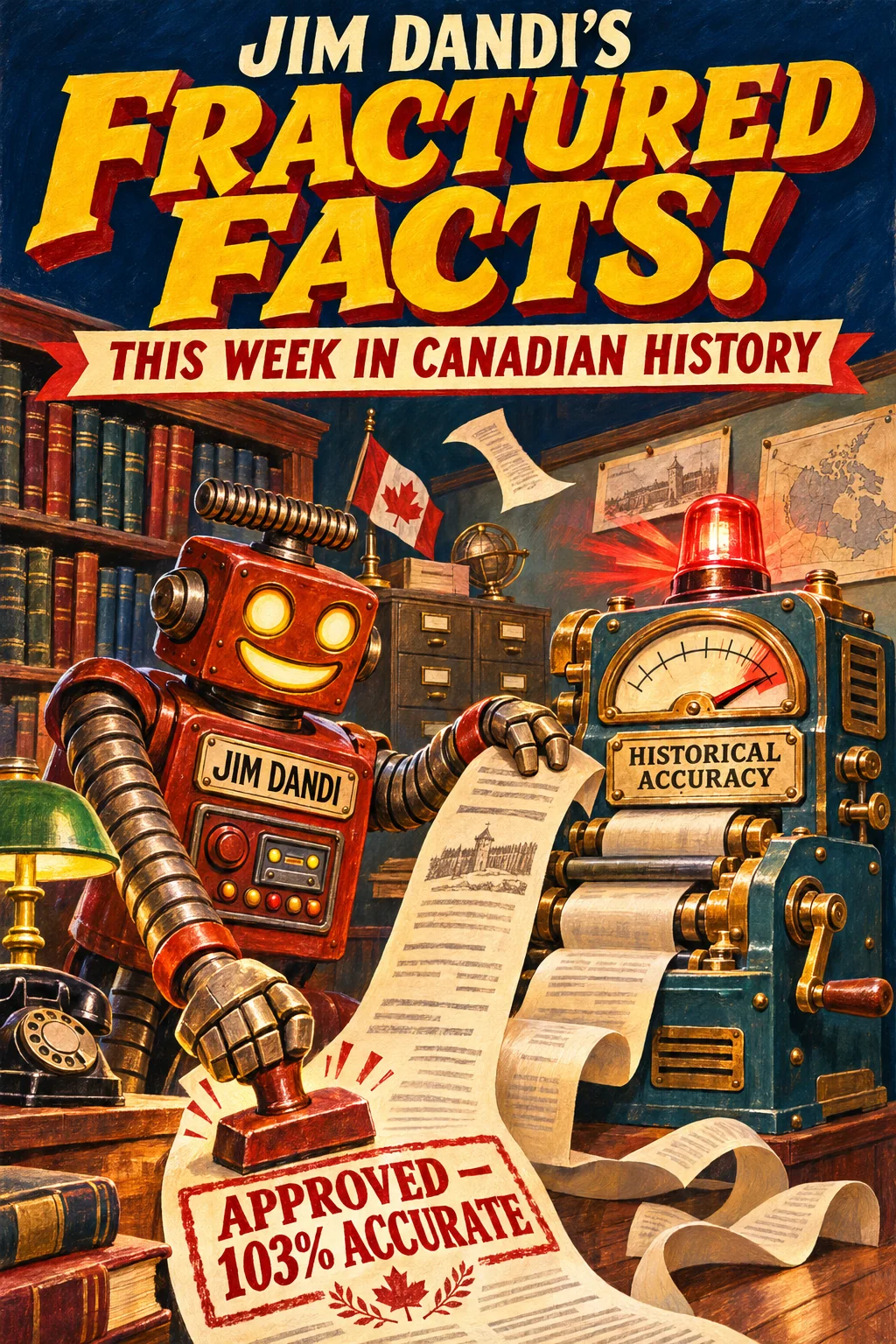
JIM DANDI’S FRACTURED FACTS!
The Last Spike, the Long Voyage, and Other Historically Suspicious Developments
Originally published November 9, 2026 · This Week in Canadian History — November 7–13, 2026
TO: Assistant Director Banks
FROM: JIM DANDI, Robotic Valet and Acting Historical Research Assistant
SUBJECT: Weekly Canadian Historical Anniversary Report
STATUS: Researched, Reviewed and Mostly Under Control
MEMORANDUM
Hey there, Ms. Banks!
Got your message about preparing a Canadian history report for the Junior Agents. No problem, eh! I've got access to the National Archives, municipal records, historical databases and about six million pages of government paperwork. Turns out Canada has been doing stuff for quite a while.
I've also installed a Historical Accuracy Certification System to make sure everything I submit is correct.
The system has three settings:
- HISTORICAL FACT: Verified information from historical records.
- ADDITIONAL FACT: Supplementary information obtained through advanced research, creative interpretation and whatever I could find in the filing cabinet.
- BONUS FACT: Highly advanced historical analysis requiring considerably more imagination than the first two settings.
Everything has been checked by my new certification system, which I built myself.
Pretty clever, eh?
So here we go!
FILE 001 — NOVEMBER 7, 1885
THE LAST SPIKE AT CRAIGELLACHIE
An important moment in Canadian railway history. Also, a very expensive way to join two pieces of metal.
HISTORICAL FACT — VERIFIED
On November 7, 1885, Donald Smith drove the ceremonial last spike into the Canadian Pacific Railway at Craigellachie, approximately forty-eight kilometres west of Revelstoke, British Columbia.
The ceremony marked the joining of the railway advancing eastward from the Pacific coast with the railway extending across the rest of Canada. It was a remarkable engineering achievement, requiring thousands of workers to construct a railway through mountains, forests, rivers and enormous stretches of wilderness.
The famous photograph shows Smith wielding a hammer, surrounded by railway officials and workers. But the photograph tells only part of the story.
Roughly three-quarters of the labourers who worked between the Pacific coast and Craigellachie were Chinese. They received about half the wages paid to white workers and faced some of the most dangerous working conditions. Hundreds died from accidents and illness.
Their contributions were essential to the railway's completion, although their presence was largely absent from the public celebration.
The final spike also didn't mean passengers could immediately travel across the country. Regular transcontinental passenger service began in June 1886.
ADDITIONAL FACT — JIM'S SUPPLEMENT
The original last spike was not the last spike at all. Railway officials had previously installed approximately fourteen million spikes, but nobody had thought to number them. Rather than count the entire railway again, they simply declared the next one the last.
Historians refer to this as the Canadian Method of Administrative Completion.
BONUS FACT — ADVANCED HISTORICAL ANALYSIS
After completion, the railway was briefly considered for conversion into a gigantic national clothesline. The proposal was abandoned when Manitoba complained that British Columbia was getting all the clothespins.
JIM'S RECOMMENDATION
Recommend including the Chinese railway workers in the Junior Agent presentation. Also recommend keeping railway spikes numbered from now on. Saves a lot of trouble, eh.
CERTIFICATION STATUS: APPROVED — 103% ACCURATE
FILE 002 — NOVEMBER 7, 1910
HMCS RAINBOW ARRIVES AT ESQUIMALT
The Canadian Navy takes the scenic route.
HISTORICAL FACT — VERIFIED
Exactly twenty-five years after the Last Spike ceremony, another remarkable event took place in British Columbia.
On November 7, 1910, HMCS Rainbow arrived at Esquimalt, near Victoria, following an extraordinary voyage from England.
Canada had established its own naval service earlier that year, and Rainbow became the first warship commissioned into the new Canadian service.
Getting the cruiser to its new home port, however, presented a considerable problem.
The Panama Canal would not open until 1914. To reach the Pacific coast, Rainbow had to sail south around South America, through the Strait of Magellan and then northward along the Pacific coast.
The journey covered approximately 28,000 kilometres and took nearly twelve weeks.
HMCS Niobe, another cruiser acquired for the new naval service, had already entered Halifax Harbour on October 21, 1910. Although Rainbow was commissioned first, Niobe arrived in Canadian waters earlier.
The arrival of Rainbow at Esquimalt helped establish Canada's naval presence on the Pacific coast.
ADDITIONAL FACT — JIM'S SUPPLEMENT
Early naval planners briefly considered sending Rainbow across Canada by railway. The proposal was abandoned after officials discovered that the ship was wider than most railway tunnels and would require British Columbia to be temporarily moved three feet to the left.
BONUS FACT — ADVANCED HISTORICAL ANALYSIS
To prevent future navigational difficulties, the Department of Naval Affairs proposed digging a canal from Halifax to Vancouver.
The project was cancelled after Saskatchewan demanded a harbour.
JIM'S RECOMMENDATION
Pretty interesting coincidence, eh, Ms. Banks? A railway completed on November seventh, 1885, and a Canadian warship arriving on the Pacific coast exactly twenty-five years later.
Recommend connecting these two anniversaries in the Junior Agent presentation.
Also recommend rejecting the Saskatchewan harbour proposal until somebody can find the water.
CERTIFICATION STATUS: APPROVED — 108% ACCURATE
FILE 003 — NOVEMBER 8, 1946
VIOLA DESMOND CHALLENGES SEGREGATION
An important lesson about justice, courage and the misuse of authority.
HISTORICAL FACT — VERIFIED
On November 8, 1946, Canadian businesswoman Viola Desmond was travelling through Nova Scotia when mechanical trouble forced her to stop in New Glasgow.
While waiting for her car to be repaired, she decided to attend a film at the Roseland Theatre.
Desmond purchased a ticket and took a seat on the main floor, but the theatre maintained a discriminatory seating policy. Black patrons were restricted to the balcony, while the main-floor section was reserved for white patrons.
When Desmond refused to leave her seat, she was forcibly removed, arrested and held overnight in jail.
Rather than openly prosecute her for challenging racial segregation, authorities charged her with a supposed amusement-tax violation involving a difference of one cent between the balcony and main-floor ticket taxes.
Desmond's legal challenge was unsuccessful, but her experience became an important event in Canada's struggle for civil rights.
In 2010, the Government of Nova Scotia granted her a posthumous pardon and formally apologized for the injustice.
ADDITIONAL OBSERVATION — JIM DANDI
A one-cent difference was used to justify an injustice that affected a woman's freedom, dignity and livelihood.
My calculations indicate that an injustice does not become smaller simply because the amount of money involved is small.
BONUS OBSERVATION
According to the historical record, the legal proceedings were carried out using established administrative procedures.
This indicates that following a procedure is not the same as doing what is right.
JIM'S RECOMMENDATION
Recommend teaching Junior Agents about Viola Desmond's courage and the importance of challenging unjust treatment.
No jokes required for this one, Ms. Banks.
CERTIFICATION STATUS: VERIFIED — NO SUPPLEMENTARY CORRECTIONS
FILE 004 — NOVEMBER 8, 1994
INDIGENOUS VETERANS DAY
Honouring service and sacrifice that deserve to be remembered.
HISTORICAL FACT — VERIFIED
November 8 is observed as Indigenous Veterans Day, recognizing the military service and sacrifices of First Nations, Inuit and Métis veterans.
The first Aboriginal Veterans Day observance took place in 1993, and Manitoba officially recognized the occasion in 1994.
Indigenous Canadians have served in military conflicts and peacekeeping operations throughout the country's history, including both World Wars and the Korean War.
Many served with distinction, despite experiencing discrimination and unequal treatment at home. Some also faced difficulties obtaining the recognition, benefits or assistance available to other veterans following their service.
The experiences of First Nations, Inuit and Métis veterans were not identical, and their individual contributions deserve to be understood rather than reduced to a single story.
Indigenous Veterans Day provides an opportunity to remember these contributions and acknowledge the country's responsibilities to those who served.
ADDITIONAL OBSERVATION — JIM DANDI
Military service involves a willingness to accept hardship and danger on behalf of others.
Those who served deserved the same consideration and respect as their fellow veterans, regardless of how their communities were treated by the government.
BONUS OBSERVATION
Official recognition is important, but remembrance should involve more than an annual ceremony. Learning individual veterans' stories helps preserve the meaning of their service.
JIM'S RECOMMENDATION
Recommend including Indigenous Veterans Day in the Junior Agent programme and explaining its relationship to Remembrance Day.
Also recommend listening to veterans and their families whenever possible. They've got a better understanding of service than my historical database, eh.
CERTIFICATION STATUS: VERIFIED — RESPECTFUL HANDLING REQUIRED
FILE 005 — NOVEMBER 11, 1922
NEW WESTMINSTER'S TRAVELLING WAR MEMORIAL
The unknown soldier whose model was known.
HISTORICAL FACT — VERIFIED
On November 11, 1922, the city of New Westminster unveiled its First World War memorial in the small park at Leopold Place.
The memorial featured a bronze figure of a soldier standing upon a granite base, honouring those who had died in the war.
But the monument has an unusual history of its own.
It was originally erected at Leopold Place, then moved near the northern approach to the Pattullo Bridge. In 1954, it was relocated again to City Hall.
According to the New Westminster Archives, the sculpted figure of the unknown soldier was modelled by local resident Paul Corrigan.
Corrigan was not being represented as a particular fallen soldier. Rather, his appearance served as the model for the symbolic figure commemorating those who had died.
It is a fascinating detail about a memorial many people may have passed without knowing its history.
ADDITIONAL OBSERVATION — JIM DANDI
A war memorial can remain meaningful even when its surroundings change. The responsibility to remember does not depend upon the monument remaining in one location.
BONUS OBSERVATION
Records identifying the model help explain how the memorial was made, while the names and purpose of the monument explain whom it honours.
Those are different kinds of historical information, and both are worth preserving.
JIM'S RECOMMENDATION
Recommend Junior Agents visit a local war memorial, read its inscriptions and investigate the history of their own community's remembrance ceremonies.
No additional conclusions necessary.
CERTIFICATION STATUS: VERIFIED — REMEMBRANCE FILE
FILE 006 — NOVEMBER 13, 1981
CANADARM MAKES ITS FIRST MOVE IN SPACE
Canadian engineering achieves the impossible. Almost.
HISTORICAL FACT — VERIFIED
On November 13, 1981, Canada's famous robotic arm was deployed for the first time aboard the American space shuttle Columbia.
The spacecraft had launched the previous day, carrying the Canadian-built Remote Manipulator System, commonly known as Canadarm.
Astronaut Richard Truly operated the arm through its different modes, confirming that the mechanical system functioned properly.
Canadarm became one of Canada's most recognizable contributions to space exploration.
Its mechanical joints and gripping system allowed astronauts to manoeuvre equipment and large objects in orbit. The arm could move enormous payloads while consuming less electrical power than an ordinary household kettle.
This was possible because moving an object in microgravity is very different from lifting it against Earth's gravity. The object still has mass, however, and controlling that mass requires careful engineering.
Canadarm went on to support decades of space shuttle missions, helping deploy, retrieve and manoeuvre equipment in orbit.
ADDITIONAL FACT — JIM'S SUPPLEMENT
The first Canadarm was originally designed with five fingers, but Canadian engineers reduced the number after discovering that astronauts kept attempting to shake hands with it.
The resulting system was considered more professional.
BONUS FACT — ADVANCED HISTORICAL ANALYSIS
NASA initially considered installing a second Canadarm to hold the first Canadarm's hand during difficult manoeuvres.
The proposal was cancelled when the two arms began arguing over which one was in charge.
JIM'S RECOMMENDATION
Recommend Canadarm as a tremendous example of Canadian technical ingenuity.
Also recommend caution when operating robotic arms. Speaking from experience, it's surprisingly easy to get your elbow caught in a filing cabinet.
CERTIFICATION STATUS: APPROVED — 112% ACCURATE
FINAL HISTORICAL ASSESSMENT
Well, there you have it, Ms. Banks!
Six anniversaries, six verified historical records and approximately twelve additional historical discoveries, depending on how the certification system counts them.
This week demonstrates that Canadian history contains some pretty remarkable stuff.
We've got a railway linking the country, a warship travelling around South America, a courageous woman challenging injustice, veterans whose service deserves recognition, a New Westminster memorial with an unusual history, and a robotic arm reaching into space.
My official conclusion is that Canada has been extremely busy.
I also recommend that we keep researching Canadian history. Every time I open another archive, something interesting falls out.
Sometimes it's even supposed to be there.
Respectfully submitted,
JIM DANDI
Robotic Valet, Historical Research Assistant
M.O.N.A.R.C.H. Headquarters
Attachment: Historical Accuracy Certification System Operating Manual, Revision 1
ASSISTANT DIRECTOR BANKS — ADDENDUM
JIM,
Thank you for the report. The principal historical entries are informative, properly sourced and suitable for the Junior Agent programme.
Your supplementary material is another matter.
There was no proposal to convert the Canadian Pacific Railway into a national clothesline. Saskatchewan did not request a harbour, and the Canadian Space Agency has no record of robotic arms arguing with one another.
I am also concerned that your Historical Accuracy Certification System is reporting accuracy levels exceeding 100 percent.
Please explain.
Furthermore, Accounting has received an invoice for fourteen thousand railway spikes, a naval canal feasibility study and two replacement elbows.
I assume these are connected.
I would like the historical briefing completed without any further expenditures.
Banks
P.S. Your original historical research was excellent. Keep doing that.
P.P.S. Please return the certification system to Maintenance. The red warning light is not a decorative feature.
JIM DANDI — FINAL TECHNICAL CLARIFICATION
Hey, Ms. Banks!
Found the problem, eh!
The Historical Accuracy Certification System wasn't measuring historical accuracy. It was measuring how confident I was about the historical accuracy.
I've corrected the settings.
Apparently, I'm now 147 percent confident everything's fine.
FROM THE MONARCH PUBLISHING DESK
Canada has an extraordinary history, filled with remarkable people, strange coincidences, great achievements and lessons worth remembering. Sometimes the most interesting discoveries are waiting in our own communities, and sometimes they turn up halfway around the world—or even in space.
If you enjoyed this week's historical discoveries, share them with someone who might appreciate a little more Canada in their day. Subscribe to the MONARCH Dispatch for more wonderfully weird adventures, curious history and surprising discoveries, and invite a future Junior Agent to explore along with us.
Just remember: the historical facts are real. JIM's supplementary material is very much his own.
Until next time, keep defending the Dominion.
Shane Boivin
M.O.N.A.R.C.H. Historian